
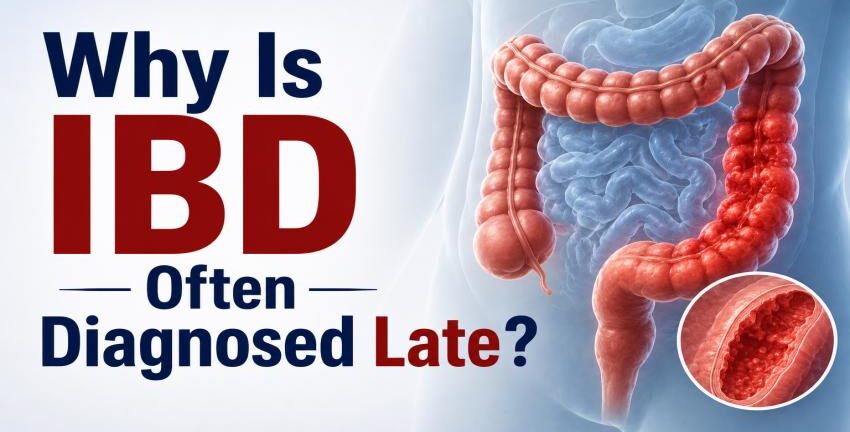
Living with stomach pain, loose motions, and fatigue for months — and still not getting a clear answer from doctors. This is the reality for thousands of IBD patients across India.
IBD (Inflammatory Bowel Disease) is one of the most underdiagnosed chronic conditions in the country. Most patients wait 1 to 5 years — sometimes longer — before getting a confirmed IBD diagnosis. At Kaizen IBD Care, Pune’s first fully dedicated IBD treatment centre, the team sees this pattern every day.
So why does this happen? And what can you do about it?
Understanding IBD and the Importance of Early Diagnosis:
IBD is a chronic inflammation of the digestive tract. The two main types are Crohn’s disease and Ulcerative Colitis. Both are lifelong conditions. Both need early, proper treatment.
When IBD is caught early, it can be controlled well. Patients live normal, active lives. But when diagnosis is delayed, the disease causes permanent damage to the intestines — leading to surgeries, hospitalisation, and serious complications. Early IBD diagnosis is not just helpful. It is life-changing.
Why Early IBD Symptoms Are So Easy to Miss? (Often Confused with IBS)
This is the biggest reason for late diagnosis.
Early IBD symptoms — loose motions, stomach cramps, bloating, and fatigue — look exactly like IBS (Irritable Bowel Syndrome). Both conditions feel very similar from the outside. IBD vs IBS is one of the most common points of confusion in gastroenterology. IBS is a functional disorder — there is no inflammation or structural damage. IBD involves actual inflammation and injury to the gut lining. Because the symptoms overlap, many patients (and even some doctors) assume it is IBS and manage it with diet and antispasmodics — without running the tests needed to confirm or rule out IBD.
This mistake causes months, sometimes years, of delay.
The Four Stages of Delay: From Symptoms to Treatment
Step 1
Patient delay:
The patient ignores symptoms or self-medicates, thinking it is a stomach infection or stress.
Step 2
Doctor delay:
The first doctor — often a general physician — treats it as IBS or a dietary issue without deeper investigation.
Step 3
Referral delay:
Even after a referral to a gastroenterologist, further tests may take weeks.
Step 4
Diagnosis delay:
Misreading of reports or atypical presentations can still push the final confirmation further.
At Kaizen IBD Care, the team is specifically trained to cut through all four stages with a structured and fast diagnostic approach.
Red Flag Symptoms That Should Never Be Ignored:
Certain IBD red flag symptoms must never be dismissed as routine stomach trouble. If you have any of these, see a specialist immediately:
- Blood in stools — even once
- Loose motions more than 4 to 6 times a day
- Waking up at night due to abdominal pain or loose motions (this never happens in IBS)
- Unexplained weight loss
- Fever with stomach pain
- Mouth ulcers that keep recurring
- Skin rashes or joint pain alongside gut symptoms
- Anal fistula or abscess in a young person
These are classic IBD symptoms that point away from IBS and toward actual inflammatory disease. Do not ignore them.
Why Doctors Sometimes Miss the Diagnosis?
It is not always the patient’s fault. Even doctors sometimes delay the IBD diagnosis. Here is why: IBD is not yet a “first thought” condition for many general physicians in India. IBS is far more common and is considered first.
- Crohn’s disease symptoms are especially tricky. Crohn’s can affect any part of the digestive tract — from the mouth to the anus. It causes skip lesions, meaning inflammation skips areas. This makes it hard to spot without detailed investigation.
- Ulcerative colitis symptoms are more consistent but can still be mild in early stages and easy to overlook.
Also, some IBD patients have predominantly extra-intestinal symptoms — joint pain, eye inflammation, skin problems — without prominent gut symptoms. These cases are especially prone to late diagnosis.
High-Risk Groups More Likely to Experience Delayed Diagnosis:
Some groups face longer diagnostic journeys:
- Young adults aged 15 to 35 — IBD is most common in this age group. But young people often avoid doctors or are told their symptoms are stress-related.
- Women — Symptoms are sometimes attributed to period-related issues or IBS, delaying IBD-specific investigation.
- People in smaller cities or towns — Limited access to gastroenterologists and specialised tests like colonoscopy leads to longer delays.
- People with a family history of IBD — Ironically, even awareness of family history does not always lead to faster diagnosis without proper medical guidance.
Crohn's Disease vs Ulcerative Colitis: Which Takes Longer to Diagnose?
Crohn’s disease diagnosis delay is typically longer than that of ulcerative colitis.
Ulcerative colitis mainly affects the colon and rectum. A colonoscopy usually reveals it clearly. Average diagnosis time is 6 to 12 months.
Crohn’s disease can affect the small intestine, which a regular colonoscopy cannot fully see. It needs additional tests like MRI enterography or capsule endoscopy. Crohn’s disease symptoms are also more varied and spread out. Average diagnosis time for Crohn’s is 1 to 3 years — sometimes much longer.
The Real-World Consequences of a Late IBD Diagnosis:
Delayed IBD diagnosis leads to serious outcomes:
- Intestinal strictures (narrowing of the bowel)
- Fistulas and abscesses
- Bowel perforation
- Need for surgery that could have been avoided
- Malnutrition and anaemia
- Reduced quality of life and mental health impact
Every month of untreated IBD causes more damage. Early treatment with the right medicines can stop this progression completely.
How Is IBD Diagnosed? Tests and Evaluations
How is IBD diagnosed? It requires a combination of tests:
- Colonoscopy with biopsy — The most important test. It directly visualises the colon and provides tissue samples to confirm inflammation.
- Blood tests — Check for anaemia, infection markers (CRP, ESR), and nutritional deficiencies.
- Stool calprotectin test — A sensitive marker that distinguishes IBD from IBS with high accuracy.
- MRI enterography — Crucial for Crohn’s disease. Shows small bowel inflammation that colonoscopy cannot reach.
- Capsule endoscopy — A swallowable camera that photographs the entire small intestine.
At Kaizen IBD Care, all these diagnostic tests are available under one roof. The team follows a structured protocol to reach an accurate diagnosis as quickly as possible.
When Should You See an IBD Specialist?
Do not wait. See a specialist if:
- You have had loose motions or stomach pain for more than 4 to 6 weeks
- You have blood in your stools
- You have lost weight without trying
- Symptoms keep coming back after initial treatment
- You have been told it is IBS, but you are not getting better
Kaizen IBD Care is Pune’s first dedicated IBD centre, located in Wakad. The clinic is run by expert gastroenterologists Dr. Vikrant Kale and Dr. Samrat Jankar, along with a full IBD care team including a gastrophysiologist, dietitian, and IBD nurse. The team at Kaizen IBD Care provides complete IBD care — from accurate diagnosis to medical management, surgical care, diet support, and long-term monitoring.
IBD does not have to control your life. But the first step is getting the right diagnosis at the right time. If your gut has been troubled for weeks and you are not getting answers, do not wait any longer. Visit Kaizen IBD Care and get the clarity you deserve.