
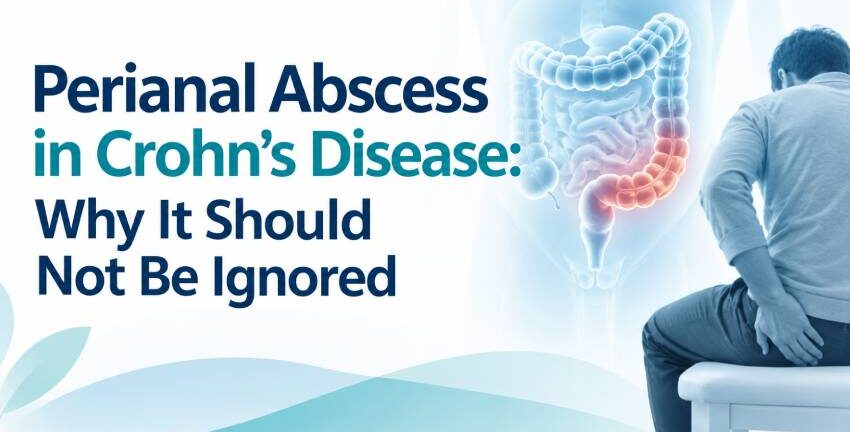
Crohn’s disease is a lifelong condition. It causes inflammation in the digestive system. But many people do not know that it can also affect the area around the anus. This is called perianal Crohn’s disease. One common and painful problem in this area is a perianal abscess.
Many patients feel shy to talk about this problem. They think it is just piles, a small boil, or a minor infection. So they wait and do not see a doctor on time. This is a mistake. Waiting can make the problem worse. It can also lead to bigger surgeries later.
In this blog, we explain everything in simple words. We cover why abscess happens, how to know the symptoms, and what treatment options are available. If you are searching for Perianal Abscess Treatment in Pune, this blog will help you understand the full picture before you visit a doctor.
At Kaizen IBD Care, Wakad, Pune, we see many patients who delay treatment out of hesitation. Dr. Vikrant Kale, along with colorectal surgeon Dr. Samrat Jankar, has treated thousands of Crohn’s disease patients and understands how uncomfortable this topic can feel. Our team believes that with the right guidance and timely care, perianal problems in Crohn’s disease can be managed well, without unnecessary fear or delay.
What Is a Perianal Abscess in Crohn's Disease?
A perianal abscess is a small pocket of pus. It forms near the anus, under the skin or in deeper tissue. Pus collects because of infection. In normal people, this can happen due to a blocked gland near the anus.
But in Crohn’s disease, the reason is different. Crohn’s disease causes deep inflammation inside the gut wall. This inflammation is not only on the surface. It goes deep and can reach tissues near the anus. When this happens, infection starts, and pus collects. This is called perianal abscess in Crohn’s disease.
This condition is more common in Crohn’s disease patients than in the general population. It is also more likely to come back if the main disease is not controlled. That is why it needs proper medical attention, not just home remedies.
Why Do Perianal Abscesses Occur in Crohn's Disease?
To understand this, we need to understand how Crohn’s disease works. In healthy people, inflammation stays only on the inner lining of the gut. But in Crohn’s disease, inflammation goes deeper. It can go through the full thickness of the gut wall.
This deep inflammation sometimes creates small tunnels. Doctors call these tunnels fistulas. These tunnels can connect the inside of the bowel to the skin near the anus. When bacteria and stool enter these tunnels, infection starts. The body’s natural response is to trap this infection in one place. This trapped infection becomes an abscess.
So, in simple words: inflammation leads to tunnels, tunnels get infected, and infection becomes an abscess. This is why Crohn’s disease abscess formation is closely linked to how active and severe the disease is. Patients with poorly controlled Crohn’s disease are more likely to face this problem again and again.
Common Symptoms of a Perianal Abscess:
An abscess does not stay silent for long. The body gives clear warning signs. Patients often notice:
- Pain and swelling near the anus – the area feels tender to touch, and swelling can increase over a few days
- Pain during bowel movements – passing stool becomes uncomfortable or even sharp and stinging
- Pus or discharge near the anus – this may stain underwear and often has a bad smell
- Fever with anal swelling – fever shows that infection is spreading and the body is fighting it
- A feeling of pressure while sitting – many patients say it feels like sitting on a hard ball
These perianal abscess symptoms should never be brushed aside, especially in patients already diagnosed with Crohn’s disease. If pain and swelling increase day by day, it is a clear sign that pus is collecting and needs to be drained.
What Is the Difference Between a Perianal Abscess and a Fistula?
Patients often get confused between these two terms. Let us make it simple.
An abscess is a closed pocket of pus. It is like a balloon filled with infection, sitting under the skin. There is no opening to drain it on its own.
A fistula is different. It is an open tunnel. This tunnel connects the inside of the bowel to the outside skin near the anus. Once this tunnel forms, fluid or pus can keep draining out from time to time.
In most cases, the abscess comes first. If it is not treated properly, the pus finds a path to escape, and this path becomes a fistula. This is why Crohn’s disease fistula and perianal fistula often go hand in hand with abscess formation. Treating the abscess early can sometimes prevent a fistula from forming at all.
Who Is at Higher Risk of Developing a Perianal Abscess?
Not every Crohn’s disease patient gets a perianal abscess. But some patients have a higher chance. Risk is higher in those with:
- Long-standing, poorly controlled Crohn’s disease – when inflammation stays active for years without proper treatment
- Colonic or rectal involvement – disease affecting the large intestine or rectum increases the chance of perianal problems
- Smoking habits – smoking is known to worsen Crohn’s disease and delay healing
- Previous perianal disease – patients who already had an abscess or fistula once are more likely to get it again
- Delayed diagnosis of IBD – when Crohn’s disease is diagnosed late, inflammation has already caused more damage
If you fall into any of these groups, regular check-ups become even more important.
How Is a Perianal Abscess Diagnosed?
A thorough evaluation is important. Diagnosis of perianal abscess usually starts with a detailed history and clinical examination. The doctor will ask about your symptoms, how long you have had them, and your history of Crohn’s disease. This is followed by imaging tests to understand the exact extent of infection, since some abscesses are deep and cannot be judged by examination alone.
What Tests Are Used to Diagnose a Perianal Abscess?
- Physical examination – the doctor gently checks for swelling, tenderness and discharge around the anus
- Pelvic MRI – gives a detailed, layer-by-layer picture of deep tissues that cannot be seen from outside
- MRI for anal fistula – helps map fistula tracts accurately, showing how many tunnels are present and where they lead
- Blood tests – check infection markers like white blood cell count and inflammation levels
- Colonoscopy when required – helps assess how active the disease is inside the bowel
- Other imaging tests when needed – such as ultrasound in select cases, especially when MRI is not immediately available
Pelvic MRI for Crohn’s disease is considered one of the most reliable tools for planning treatment. It helps the surgeon understand the exact location of the abscess and any hidden fistula tracts before deciding on the treatment plan. This reduces the chance of missing a problem during surgery.
Why Should a Perianal Abscess Not Be Ignored?
Many patients delay treatment due to embarrassment or fear. However, an untreated abscess does not heal on its own. It keeps growing and can damage healthy tissue around the anus, including the muscles that control bowel movements.
Complications of an Untreated Perianal Abscess:
If a perianal abscess is not treated on time, the infection does not stay in one place. It slowly spreads. This can lead to:
- Spread of infection to nearby tissue – infection can travel to muscles and fat around the anus
- Formation of complex fistulas – simple problems can turn into multiple, branching tunnels that are harder to treat
- Damage to the anal sphincter muscles – these muscles control bowel movements; damage can cause loss of control
- Sepsis in severe cases – infection can enter the bloodstream and become life-threatening
- Poor quality of life due to chronic pain – ongoing pain affects sitting, walking, sleep and daily work
This is why doctors always say: do not wait for the abscess to burst on its own. Early treatment is always simpler, safer and less costly than treating complications later.
Perianal Abscess Treatment in Crohn's Disease:
Treatment depends on the size and depth of the abscess. There is no one-size-fits-all approach. Small, superficial abscesses may need simple drainage. Deep or complex abscesses need careful surgical planning, sometimes with MRI guidance.
The main goal is always the same: drain the pus, control infection, and then start long-term Crohn’s disease management. Perianal abscess treatment is usually combined with medical therapy for the underlying disease, because treating only the abscess without controlling Crohn’s disease often leads to the problem coming back.
Role of Antibiotics in Perianal Abscess Treatment:
Many patients ask, “Can I just take antibiotics and avoid surgery?” The honest answer is no, in most cases.
Antibiotics for perianal abscess help control infection, especially before or after drainage. They reduce the spread of infection and help the body fight bacteria. But antibiotics cannot remove pus that is already collected in a closed pocket. Medicine alone cannot dissolve pus.
This is why drainage is almost always necessary for proper healing. Antibiotics work best as a support treatment, not as the only treatment.
When Is Surgery Needed for a Perianal Abscess?
Abscess drainage surgery is required when there is a collection of pus that needs to be released. Waiting for it to burst on its own is not a good idea, as it can spread infection further before draining.
This is usually a short procedure done under anaesthesia. A small cut is made to let the pus out, and the area is cleaned properly. Though it sounds minor, it must be done by an experienced surgeon. The anal area has delicate muscles that control bowel movements, and careless surgery can damage them. In many cases, this drainage is just the first step, and further Crohn’s disease surgery is planned later once the acute infection settles down.
What Is Seton Placement and When Is It Used?
Seton placement is a special technique used when a fistula is present along with the abscess. A seton is simply a soft, thin thread. The surgeon passes this thread through the fistula tract.
Why is this useful? The thread keeps the tunnel open. This allows pus and fluid to drain continuously, instead of collecting again and forming a new abscess. It also lets the inflammation settle down slowly, without cutting through the muscle in one go.
Seton treatment for anal fistula is a well-established, sphincter-sparing surgery. This means it protects the muscles that control bowel movements while healing takes place. Many patients keep the seton in place for weeks or months, depending on how the fistula responds to treatment.
Role of Biologic Therapy in Perianal Crohn's Disease:
Surgery treats the abscess and fistula. But it does not treat the root cause, which is Crohn’s disease itself. This is where biologic therapy comes in.
Biologic therapy for Crohn’s disease uses special medicines that target the exact proteins causing inflammation in the body. These medicines help calm down the overactive immune response. When inflammation reduces, the chance of new fistula or abscess formation also reduces.
Biologics are often used along with surgery for better long-term results. Surgery clears the current infection, and biologics help prevent the next one. This combined approach is part of advanced Crohn’s disease treatment offered by IBD specialists, and it has changed outcomes for many perianal Crohn’s disease patients over the last decade.
Recovery After Perianal Abscess Treatment:
Recovery time varies from patient to patient. It depends on the size of the abscess, whether a fistula was also present, and how well the underlying Crohn’s disease is controlled.
Most people feel relief from pain soon after drainage, often within a day or two. But complete healing of the wound takes longer, usually a few weeks. During this time, sitz baths (warm water soaking), proper hygiene and wound care help the area heal cleanly.
Regular follow-up, wound care and continued Crohn’s disease medication are important for complete healing. Skipping follow-up visits or stopping medicines early is one of the common reasons for recurrence.
Can a Perianal Abscess Come Back?
Yes, recurrence is possible, especially if the underlying Crohn’s disease is not well controlled. Even after successful drainage or seton removal, if the gut inflammation stays active, a new abscess can form in a different spot. This is why long-term management under an IBD specialist is important, not just one-time treatment. Treating the abscess is only half the job; controlling Crohn’s disease is the other, more important half.
How to Reduce the Risk of Future Perianal Abscesses?
Simple lifestyle steps can make a big difference:
- Take Crohn’s disease medicines regularly – do not stop or skip doses even if you feel better
- Avoid smoking – smoking is strongly linked to worse perianal disease and poor healing
- Attend regular follow-up visits – this helps the doctor catch problems before they become severe
- Report new symptoms early – do not wait for pain to become unbearable before seeking help
- Maintain good hygiene in the perianal area – gentle cleaning after bowel movements reduces infection risk
Following these steps does not guarantee zero risk, but it significantly lowers the chances of recurrence.
When Should You See an IBD Specialist?
If you have Crohn’s disease and notice any swelling, pain or discharge near the anus, do not wait. Consulting an experienced IBD Specialist early can prevent complications and reduce the need for repeated surgeries.
When Perianal Symptoms Need Urgent Medical Attention?
Seek urgent care if you notice:
- High fever with chills
- Severe, worsening pain
- Rapidly increasing swelling
- Inability to sit or pass stools
Consult Dr. Vikrant Kale for Perianal Crohn's Disease:
Dr. Vikrant Kale, a highly experienced gastroenterologist, hepatologist and interventional endoscopist with over 18+ years of experience, leads advanced IBD care at Kaizen IBD Care. With fellowships from Oxford University in GI Endoscopy and Inflammatory Bowel Disease, Dr. Vikrant Kale, along with colorectal surgeon Dr. Samrat Jankar, offers complete Crohn’s Disease Treatment, including perianal abscess management, fistula surgery and long-term biologic therapy.
If you are looking for a trusted Crohn’s Disease Specialist in Pune or a complete IBD Treatment Center in Pune, Kaizen IBD Care provides evidence-based, patient-focused treatment for lasting relief.
Conclusion: Early Treatment Can Prevent Serious Complications
A perianal abscess in Crohn’s disease should never be ignored. Early diagnosis and timely Perianal Crohn’s Disease Treatment can prevent complications, protect bowel function and improve quality of life. If you notice any symptoms, consult an experienced IBD specialist without delay.
Do not let hesitation or fear delay your treatment. Book an appointment with Dr. Vikrant Kale and at Kaizen IBD Care, Pune, and take the first step towards proper diagnosis and lasting relief. Our team is happy to guide you through the entire treatment process.
Frequently Asked Questions About Perianal Abscess in Crohn's Disease
It is a pocket of pus that forms near the anus due to inflammation caused by Crohn’s disease. This inflammation goes deep into the tissue and creates small tunnels where infection can collect. It is more common in Crohn’s disease patients than in the general population. If not treated, it can grow bigger and cause more pain.
Deep inflammation and blocked tunnels, called fistulas, in the perianal area lead to infection and pus formation. In Crohn’s disease, this happens because inflammation goes through the full thickness of the gut wall. Bacteria and stool can enter these tunnels and cause infection. Over time, this trapped infection turns into an abscess.
Yes, it usually causes significant pain, swelling and discomfort, especially while sitting or passing stools. Many patients describe it as a throbbing pain that gets worse over a few days. The area may also feel warm and tender to touch. Fever can occur if the infection is spreading.
No, it needs proper drainage. It does not resolve completely on its own. Antibiotics may reduce the infection slightly, but the pus pocket usually remains. Without drainage, the abscess can grow larger and lead to serious complications. Timely treatment is always safer than waiting.
Most abscesses need drainage, which is a minor surgical procedure done under anaesthesia. The extent of surgery depends on the size, depth and location of the abscess. Small, superficial ones may need simple drainage, while deeper ones need more careful planning. Your doctor will decide the best approach after examination and imaging.
An abscess is a closed pus pocket, while a fistula is a tunnel connecting the bowel to the skin. An abscess builds up pressure since it has no outlet, causing pain and swelling. A fistula, on the other hand, allows fluid to drain out slowly and continuously. Many patients develop a fistula after an abscess is not treated properly.
Yes, especially if Crohn’s disease is not well controlled. Even after successful drainage, active inflammation elsewhere can lead to a new abscess. Regular follow-up and continued medication reduce this risk significantly. This is why long-term IBD management matters as much as the initial treatment.
Yes, biologic therapy helps control inflammation and lowers the chances of future abscess or fistula formation. These medicines target the specific proteins responsible for ongoing inflammation in Crohn’s disease. When combined with surgery, they give better long-term results. Many IBD specialists now recommend biologics as part of standard perianal Crohn’s disease care.
Kaizen IBD Care is led by Dr. Vikrant Kale and colorectal surgeon Dr. Samrat Jankar, who together bring years of specialised experience in treating complex Crohn’s disease cases. The clinic offers advanced diagnosis, minimally invasive surgery and long-term biologic therapy under one roof. Patients get evidence-based, personalised care instead of a one-size-fits-all approach. This combined expertise helps reduce recurrence and improves long-term quality of life.