
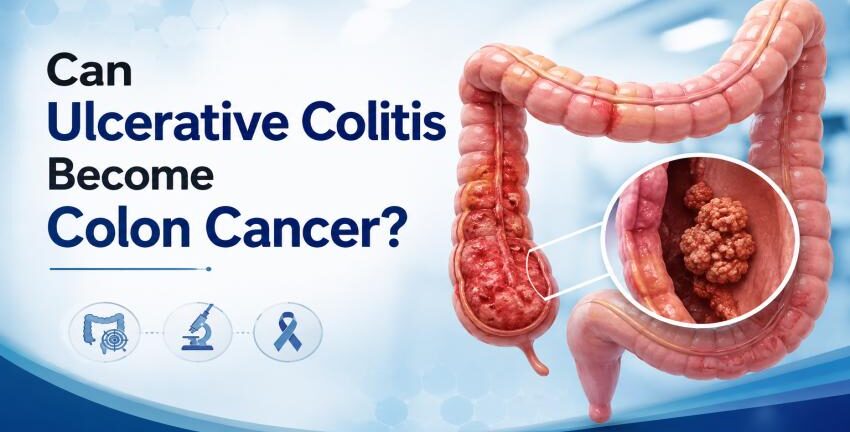
Many patients with ulcerative colitis ask one common question. Can this disease turn into colon cancer? This fear is natural, and it is important to understand the real facts, without panic.
Ulcerative colitis is a long-term disease of the large intestine. It needs proper care and regular follow-up. In this blog, we will explain the link between ulcerative colitis and colon cancer in simple words. We will also tell you the risk factors, warning signs, and steps you can take to protect yourself.
Dr. Vikrant Kale, IBD specialist at Kaizen IBD Care, Pune, has treated thousands of ulcerative colitis patients. In this blog, he shares his knowledge on this important topic.
What Is Ulcerative Colitis?
Ulcerative colitis is a type of inflammatory bowel disease, also called IBD. In this disease, the inner lining of the large intestine, called the colon, gets inflamed. Small ulcers or wounds form on this lining. This causes pain and discomfort in daily life.
Common ulcerative colitis symptoms include:
- Blood in stool
- Rectal bleeding
- Diarrhea with blood
- Abdominal pain
- Mucus in stool
- Weight loss
- Change in bowel habits
These symptoms can come and go. Some days feel normal, and some days can be very painful. This is why proper ulcerative colitis treatment and regular doctor visits are so important. Without treatment, the inflammation can continue silently, even when symptoms feel mild.
Can Ulcerative Colitis Increase the Risk of Colon Cancer?
This is the main question most patients ask: can ulcerative colitis become colon cancer?
The honest answer is this. Ulcerative colitis does not directly turn into cancer on its own. But if the inflammation stays in the colon for a long time, without proper control, it can slowly increase the colon cancer risk in ulcerative colitis patients.
This does not mean every patient with ulcerative colitis will get colon cancer. Many patients live a full, healthy life with proper treatment. But the risk is higher compared to people without this disease. This is exactly why doctors focus so much on regular monitoring for long-term ulcerative colitis patients.
Why Does Ulcerative Colitis Increase Colon Cancer Risk?
To understand this better, let us look at what happens inside the colon over time. Chronic colon inflammation means the colon lining is repeatedly getting irritated and healing, again and again, for years. This constant cycle of damage and repair can slowly cause changes in the cells of the colon.
Sometimes, these cells start growing in an abnormal way. This is called dysplasia in ulcerative colitis. Dysplasia is not cancer yet, but it is considered a precancerous colon change. If dysplasia is not found and treated in time, in some cases, it can develop into colorectal cancer.
The ulcerative colitis cancer risk becomes higher when:
- The inflammation is severe
- A large part of the colon is affected
- The disease has been active for many years without good control
This is why doctors always stress on keeping the disease well controlled, not just managing symptoms when they appear.
Who Is at Higher Risk of Colon Cancer with Ulcerative Colitis?
Not every patient has the same risk level. Some patients need to be more careful and alert. You may be at higher risk if you have:
- Long duration of disease – Ulcerative colitis for more than 8 to 10 years
- Severe or extensive disease – When inflammation covers a large part of the colon, not just a small area
- Family history – If a close family member has had colorectal cancer
- Poorly controlled inflammation – When symptoms are not managed well over time
- Associated liver condition – A condition called primary sclerosing cholangitis, which is linked with higher risk
If any of these points apply to you, please talk to your doctor about a proper screening plan. Being aware of your personal risk level helps you and your doctor plan better care.
Warning Signs You Should Never Ignore:
Some symptoms need urgent medical attention. Please do not ignore these colon cancer warning signs:
- Blood in stool or rectal bleeding that does not stop
- Diarrhea that continues for a long time, especially with blood
- Sudden or unexplained weight loss
- Constant abdominal pain that does not go away
- A clear change in your normal bowel habits
- Ongoing tiredness or weakness without a clear reason
These are also common colon cancer symptoms. If you notice any of these signs, please visit your doctor as soon as possible. Early attention can make a big difference in outcome.
How Doctors Check for Colon Cancer in Ulcerative Colitis Patients?
The main tool doctors use is a colonoscopy for ulcerative colitis patients. During this test, a thin tube with a camera is gently passed into the colon. This allows the doctor to see the entire colon lining clearly.
If the doctor notices any unusual area, a small sample is taken. This is called a colon biopsy. This tissue sample is then studied carefully under a microscope. The lab checks if the cells are normal, show dysplasia, or show signs of cancer.
This complete process is known as cancer surveillance in ulcerative colitis. It is done regularly, not just once, because the colon can change over time. Regular surveillance means problems are caught early, often before they turn into serious cancer.
How Often Should You Get a Colonoscopy?
The frequency of colonoscopy screening depends on your personal risk level. As a general guide:
- Screening usually begins around 8 to 10 years after your first ulcerative colitis diagnosis
- If you are at higher risk, your doctor may recommend a colonoscopy every 1 to 2 years
- If your risk is lower, a colonoscopy every 2 to 3 years may be enough
Please remember, this schedule is not the same for everyone. Your gastroenterologist will look at your disease history, severity, and other factors before deciding the right plan for you. Do not skip these appointments, even if you are feeling fine.
Can Colon Cancer Be Prevented If You Have Ulcerative Colitis?
Yes, colon cancer prevention is very much possible, even with ulcerative colitis. The key lies in good, consistent management of your disease.
When your ulcerative colitis is well controlled through proper medicines, regular follow-ups, and timely colonoscopy screening, your overall risk becomes much lower. Also, when problems are caught early, through early diagnosis of colon cancer, treatment becomes simpler and results are much better.
The main message here is simple. Do not wait, do not skip check-ups, and do not ignore symptoms. Prevention is truly better than cure in this case.
Tips to Reduce Your Risk of Colon Cancer:
Here are some practical, easy-to-follow tips:
- Take your IBD medicines regularly, exactly as prescribed by your doctor
- Never skip your scheduled follow-up appointments
- Go for colonoscopy screening as advised, even if you feel healthy
- Eat a balanced diet that supports good colon health and gut health
- Avoid smoking completely
- Limit alcohol consumption
- Maintain a healthy body weight through regular activity
- Report any new or unusual symptoms to your doctor immediately, without delay
These small, consistent habits, done over time, can meaningfully lower your colorectal cancer risk factors.
Treatment Options If Abnormal Cells Are Found?
If your doctor finds dysplasia or early cancer cells during a colonoscopy, do not panic. Treatment depends on how advanced the changes are:
- Mild dysplasia may simply need closer monitoring, with more frequent colonoscopy visits to track any changes
- More advanced dysplasia may need removal of the affected tissue during an endoscopic procedure itself
- Confirmed early cancer may need surgery to remove the affected part of the colon
Every case is different. Your doctor will study your reports carefully and explain the best treatment path suited to your specific condition and overall health.
When Should You Consult a Gastroenterologist?
Please book a visit to a gastroenterologist in Pune if you experience:
- Ongoing or worsening symptoms of ulcerative colitis
- Blood in stool or rectal bleeding
- A family history of colon cancer
- Long-standing IBD without recent check-ups or colonoscopy
Do not wait for symptoms to get worse before seeking help. A timely visit to a digestive disease specialist in Pune can catch problems early, when they are most treatable.
Why Choose Dr. Vikrant Kale for Ulcerative Colitis Treatment in Pune?
When it comes to managing a lifelong condition like Ulcerative Colitis, you deserve a specialist who treats the actual disease, not just the symptoms. Here’s why patients across Pune trust Dr. Vikrant Kale:
International Training:
Dr. Vikrant Kale completed his MBBS from MIMER, Pune, in 2003, followed by MRCPI from The Royal College of Physicians of Ireland in 2009, and a Fellowship in Inflammatory Bowel Disease from Oxford University, UK, in 2018.
17+ Years of Experience:
With over 17 years in gastroenterology and hepatology, Dr. Kale brings deep, hands-on expertise in managing both simple and complex IBD cases.
Focused IBD Expertise:
As a dedicated IBD specialist, he understands Ulcerative Colitis and Crohn's Disease as lifelong conditions, requiring continuous monitoring, timely treatment adjustment, and close attention to complications like colon cancer risk.
Complete Care Team:
At Kaizen IBD Care, Dr. Kale works closely with colorectal surgeon Dr. Samrat Jankar, bringing 20+ years of combined experience, 10,000+ patients treated, and 1,000+ successful IBD surgeries.
Advanced Treatment Options:
The clinic offers advanced endoscopy, minimally invasive surgery, and regular colonoscopy screening for early detection and prevention.
Trusted Across Pune:
Patients from Wakad, Baner, Aundh, Hinjewadi, and Pimpri-Chinchwad rely on Dr. Vikrant Kale and Kaizen IBD Care for complete, compassionate IBD care.
Conclusion:
Ulcerative colitis does not directly turn into colon cancer. But if the inflammation stays uncontrolled for a long time, it can raise your risk over the years. The good news is that this risk can be managed well, through regular colonoscopy screening, proper medicines, and healthy lifestyle habits.
If you are living with ulcerative colitis, please do not delay your check-ups, even if you feel fine right now. Staying consistent with your care today can protect your health for many years to come.
For expert guidance and personalised care, visit Dr. Vikrant Kale at Kaizen IBD Care, Wakad, Pune. Your gut health deserves timely attention, so take the first step today.
Frequently Asked Questions (FAQs):
Ulcerative colitis does not directly cause colon cancer, but long-term, uncontrolled inflammation can raise the risk over time.
Screening usually starts 8 to 10 years after diagnosis, then continues every 1 to 3 years, depending on your personal risk level.
Blood in stool, ongoing diarrhea, weight loss, abdominal pain, and change in bowel habits are important warning signs that need medical attention.
Yes, keeping the disease well controlled with proper medicines and regular colonoscopy screening can significantly lower the risk.
Dr. Vikrant Kale has 17+ years of experience, international training from Ireland and Oxford University, UK, and has helped thousands of IBD patients through expert, personalised care at Kaizen IBD Care.